Radical Help by Hilary Cottam
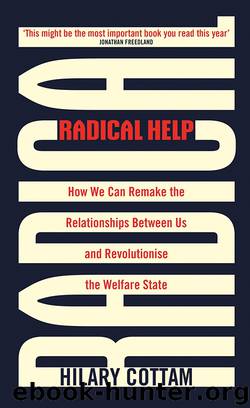
Author:Hilary Cottam [COTTAM, HILARY]
Language: eng
Format: epub
ISBN: 9780349009087
Publisher: Little, Brown Book Group
Published: 2018-06-06T16:00:00+00:00
Experiment #5: Ageing Well
Roy beckons to me from the hallway of his flat. Come through the door, he signals, waving his hands. He has misplaced his hearing aid and he wants me to look for it. I feel down the back of sofas and chairs, I go carefully through his bedroom drawers and his bathroom cabinet. I feel a bit uncomfortable and I try not to be too intrusive. And then I find it – behind the toaster in the kitchen. Roy gives it a cursory wipe, pops it in and offers me a cup of tea. With his hearing aid in place he becomes loquacious. Roy loves classical music – do I like opera? He also loves sausage-making – would I like to learn? Roy starts to tell me, in great detail, about the art of the sausage: the skins, the herbs, the ratio of fat to meat.
As I listen to Roy and watch him, busy in his warm kitchen, I realise that he is a happy man, comfortable in his skin and absorbed by his love of music and cooking. He is eighty-six, he tells me, and well; he has aches and pains, but he can’t grumble. As I worked my way through his home in my hunt for his hearing aid, I learnt quite a lot about Roy. I know about his health, I have seen most of his possessions and I have observed other small and personal things. Some of them we won’t talk about and others could not be expressed on an ‘assessment’ form, but they will help me, in the months to come, to think about what might keep Roy happy and independent for longer and how we could include him in any plans we make.
What is life for? In the Buddhist tradition, this question can only be answered in our later years. As we age, we gain perspective, and like Roy we understand what makes us happy. And so in the Buddhist teaching the third stage of our lives is a critical time for learning, for liberating our capabilities and – perhaps – for finding enlightenment.1
How painfully such a narrative of ageing contrasts with the stories we in the West tell of old age. We might celebrate our birthdays and talk proudly about increased life expectancy, but most of us fear the ageing process. We see it as a stage of loss, of diminished capability and of scarcity. We fear and push to the back of our minds a time when we might not have enough money, when those we love may have died or just lost interest in us, and when our memories may be faded.
We are growing old. And our existing welfare arrangements, which were not designed for current demographics, are under intolerable strain. These systems have helped us to live longer, but now they cannot help us age well.
Policy-makers and broadcasters do not talk about a flourishing old age, much less enlightenment. Rather, they routinely speak of ‘time bombs’ and ‘burdens’, of the ‘floodgates’.
Download
This site does not store any files on its server. We only index and link to content provided by other sites. Please contact the content providers to delete copyright contents if any and email us, we'll remove relevant links or contents immediately.
| Anthropology | Archaeology |
| Philosophy | Politics & Government |
| Social Sciences | Sociology |
| Women's Studies |
Remedy and Reaction by Paul Starr(1241)
The Rise of Theodore Roosevelt by Edmund Morris(1225)
The Saddest Girl in the World by Cathy Glass(1047)
Damaged: The Heartbreaking True Story of a Forgotten Child by Cathy Glass(1032)
A Slender Thread by Diane Ackerman(1014)
Gaia by Lovelock James(1004)
The Complete Idiot's Guide to Forensics by Alan Axelrod(932)
Global Health Watch 4 by Global Health Watch(928)
The Light Between Oceans by M. L. Stedman(920)
The Varieties of Psychedelic Experience: The Classic Guide to the Effects of LSD on the Human Psyche by Robert Masters Ph.D. & Ph.D. Houston Jean(835)
I by Anonymous(832)
Hidden: Betrayed, Exploited and Forgotten. How One Boy Overcame the Odds. by Cathy Glass(825)
The End of Epidemics by Dr. Jonathan D. Quick(825)
Theodore Rex by Edmund Morris(812)
Trump's War by Michael Savage(794)
Just Another Kid by Torey Hayden(773)
Trees in Trouble by Daniel Mathews(765)
Buzzed by Cynthia Kuhn(762)
Biopiracy by Vandana Shiva(740)
